Mortgage Documents
New CFPB Proposal Threatens Mortgage Protections: What Homeowners Need to Know
As the CFPB considers weakening critical mortgage disclosure rules, consumer advocates warn of a rise in predatory lending and foreclosure risks.


Disclaimer: The information provided in this article is for educational purposes only and does not constitute legal advice. If you are facing foreclosure or legal action, please consult with a qualified attorney in your jurisdiction.
In August 2026, a coalition of major consumer and housing advocacy organizations—including the National Consumer Law Center (NCLC) and the National Housing Law Project—sounded a massive alarm. They issued an urgent warning that the Consumer Financial Protection Bureau (CFPB) is considering proposals that would unravel vital federal protections for mortgage borrowers. Specifically, these rollbacks target the Truth in Lending Act (TILA) and the Real Estate Settlement Procedures Act (RESPA), which collectively form the bedrock of modern borrower rights.
For homeowners, this isn't just dry regulatory news. The softening of these rules is a direct threat to the financial safety of American families. When lending regulations are weakened, the door is kicked wide open for predatory lending, mortgage fraud, and a tidal wave of servicing abuses that ultimately end in foreclosure.
Understanding what is at stake—and how to protect your homeowner rights when federal guardrails are removed—is no longer optional. It is a mandatory survival skill.
The Latest News: Unraveling TRID and Mortgage Disclosures
The current battleground involves the TILA-RESPA Integrated Disclosure (TRID) rules, often referred to as the "Know Before You Owe" regulations. The CFPB developed the current TRID regime after the 2008 financial crisis, following years of documented evidence that lenders were taking advantage of the sheer complexity of mortgage transactions to saddle consumers with hidden fees, unfair charges, and inflated interest rates.
TRID requires lenders to provide borrowers with clear, standardized documents at two critical stages of the mortgage process: the Loan Estimate (provided shortly after applying) and the Closing Disclosure (provided at least three days before closing). These mortgage documents were designed to force transparency. They allow borrowers to see exactly what they are paying, how much the lender is making, and whether the loan terms changed at the last minute.
According to recent comments submitted by consumer advocates, the CFPB's new proposals seek to review and potentially soften these timing and tolerance rules. Lenders argue that the rules are too rigid and costly to implement. However, consumer protection attorneys argue that weakening these regulations will effectively "open the door for disreputable lenders to prey on consumers and saddle them with risky loans."
When borrowers do not receive clear, timely, and legally binding disclosures, they often sign contracts they do not fully understand. Historically, this has led to a dramatic increase in unaffordable loans. And an unaffordable loan is the very first domino in the long, devastating chain reaction of default and foreclosure.
Why the Right of Rescission is a Lifeline for Borrowers
One of the most fiercely debated elements of the current CFPB review involves the "rules of rescission." Under the Truth in Lending Act, borrowers refinancing a primary residence or taking out a home equity loan have a three-day window to cancel the transaction without penalty. This is known as the Right of Rescission.
 A magnifying glass and legal files on a dark desk illuminated by a warm gold lamp, representing the forensic review of mortgage documents.

Why does this matter? Mortgage transactions are notoriously complex. At the closing table, borrowers are frequently presented with a mountain of dense, legally intimidating mortgage documents. Lenders and closing agents often apply immense pressure to simply "sign on the dotted line" to get the deal done. In this high-stress environment, it is incredibly easy for a borrower to overlook a toxic loan feature, such as a balloon payment, an adjustable-rate trap, or exorbitant junk fees.
The three-day rescission period serves as an emergency brake. It allows a borrower to take the documents home, read them in peace, consult a financial advisor, and pull out of the deal if they realize they have been pressured into a bad loan.
Consumer advocates warn that any attempt to dilute the pre-consummation disclosures or the right of rescission is a direct attack on homeowner rights. Without this three-day "cooling off" period, families trapped by deceptive lending practices lose their primary escape route. Once a toxic loan is fully consummated, breaking free from it usually requires expensive litigation or, tragically, results in the loss of the home.
How Weak Disclosures Fuel Servicing Abuses and Foreclosure
The consequences of weakened mortgage regulations do not end at the closing table; in fact, that is where the danger truly begins. When a borrower is locked into a predatory or confusing loan, the likelihood of default skyrockets. Once a loan defaults, the borrower is thrust into the notoriously aggressive world of mortgage servicing.
Mortgage servicers are the companies that collect your monthly payments, manage your escrow account, and initiate foreclosure proceedings if you fall behind. They are rarely the original lender. Because they profit from fees rather than the underlying interest of the loan, the servicing industry has historically been ripe with servicing abuses.
If the underlying mortgage documents are legally sloppy—a direct result of weakened TRID regulations—servicers can easily exploit the confusion. Common servicing abuses include:
- Misapplied Payments: Applying borrower payments to arbitrary late fees or "corporate advances" rather than the principal and interest.
- Force-Placed Insurance: Falsely claiming a borrower lacks homeowners insurance and purchasing an astronomically expensive policy on their behalf.
- Dual Tracking: The illegal practice of negotiating a loan modification with a borrower while simultaneously pushing the home toward a foreclosure auction.
When a borrower attempts to fight these abuses, they must rely on their original closing documents to prove the servicer violated the terms of the contract. If the CFPB weakens what must be disclosed and documented at closing, it essentially disarms the homeowner before the fight even begins.
The Legacy of Robo-Signing and the Danger of Unverified Assignments
To understand why strict documentation rules are vital, we must look at the dark history of bank fraud in the United States. Following the 2008 housing crash, investigations revealed that major financial institutions were engaged in a massive, systemic fraud known as "robo-signing."
Because mortgages were bought, sold, and bundled into securities at lightning speed, banks often lost the original promissory notes and failed to properly record the assignments of mortgage. An assignment is the legal document that officially transfers the rights of the mortgage from one bank to another. Without a valid assignment, a bank has no legal standing to foreclose on a home.
To cover up the fact that they had lost the paperwork, banks hired low-wage workers to forge signatures on hundreds of thousands of foreclosure affidavits and assignments per day—hence the term "robo-signing." They manufactured fake evidence to steal homes through the court system.
While the government eventually levied billions in fines against the banks, the underlying vulnerability remains. Mortgages are still bought and sold on the secondary market. Assignments are still frequently lost, botched, or improperly drafted. If federal regulators reduce their oversight of how mortgage documents are generated and managed, we risk a return to an era where banks can rely on unverified, legally dubious paperwork to strip families of their homes.
In a foreclosure defense scenario, forcing the bank to prove their chain of title through valid, legally compliant assignments is one of the most powerful strategies a homeowner has. Weakening the rules surrounding these documents only empowers the institutions seeking to foreclose.
Protecting Your Homeowner Rights When Federal Guardrails Fall
If the CFPB proposal moves forward and federal lending protections are gutted, the burden of defense falls entirely on the shoulders of the homeowner. You can no longer rely on federal regulators to automatically shield you from predatory lending, bank fraud, or servicing abuses. You must become your own best advocate.
Protecting your home requires a proactive, educated approach:
- Audit Your Own Mortgage Documents: Do not blindly trust the paperwork handed to you by your servicer. You must meticulously organize your Loan Estimate, Closing Disclosure, Promissory Note, Mortgage (or Deed of Trust), and any recorded assignments. Look for mathematical discrepancies, hidden fees, or missing signatures.
- Monitor Your Servicer Like a Hawk: Keep detailed, chronological records of every payment you make. Save every monthly statement and cross-reference how your payment is being applied to principal, interest, and escrow. If a servicer claims you are in default, demand a complete payment history and a validation of the debt.
- Understand the Chain of Title: If you are facing foreclosure, the very first question you must ask is: Does this specific financial institution have the legal right to foreclose? By demanding to see the original note and the complete chain of assignments, you can force the bank to prove their standing. Often, they cannot.
- Educate Yourself on Court Procedures: If a foreclosure case is filed against you, you must understand how evidence is presented, how discovery works, and what legal deadlines apply in your state. Ignorance of court procedure is the easiest way for a bank to win a default judgment against you.
Knowledge is the ultimate equalizer in the fight against massive financial institutions. By educating yourself on the mechanics of your loan and the rules of the legal system, you can spot fraud, fight back against abuses, and fiercely defend your most valuable asset.
Why the Foreclosure Defense Survival Playbook Helps
When federal agencies consider rolling back consumer protections, homeowners are left vulnerable to predatory lending, aggressive servicing abuses, and the terrifying threat of foreclosure. The banking industry relies on the fact that the average borrower does not understand the complexities of mortgage documents, the chain of title, or the rules of legal evidence.
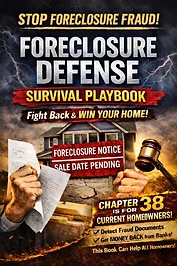
This is exactly why the Foreclosure Defense Survival Playbook is a mandatory resource for any homeowner.
At 530 pages, this deeply educational book is designed to demystify the entire mortgage and default process. It translates complex legal jargon into plain language, empowering you to audit your own mortgage documents, spot invalid assignments, and organize your evidence with a forensic level of detail. The Playbook walks you through the strategies necessary to hold mortgage servicers accountable, understand the critical discovery process in court, and conduct effective legal research without feeling overwhelmed.
Whether you are trying to understand a suspicious fee on your monthly statement, researching how to challenge a broken chain of title, or preparing to navigate the court system, this book provides the step-by-step educational foundation you need. You don't have to face the threat of foreclosure in the dark. Order the Foreclosure Defense Survival Playbook today and arm yourself with the knowledge to fight back and protect your home.

Order The Playbook
Get the Foreclosure Defense Survival Playbook
530 pages of structured, educational guidance covering mortgage documents, foreclosure procedures, evidence organization, and legal research — the same foundation this article draws from.