Foreclosure Defense
CFPB Declares Ineffective Mortgage Servicing an Abusive Practice: What It Means for Your Foreclosure Defense
Recent CFPB enforcement actions have officially classified ineffective mortgage servicing as an abusive practice. Discover how this impacts homeowner rights and foreclosure defense strategies.
Disclaimer: The following article is for educational purposes only and does not constitute legal advice. If you are facing foreclosure, please consult with a qualified attorney in your jurisdiction.
For homeowners struggling to keep up with mortgage payments, the threat of foreclosure is a terrifying reality. However, recent regulatory actions and legal precedents are shifting the landscape of homeowner rights. The Consumer Financial Protection Bureau (CFPB) has recently taken a hardline stance against mortgage servicers who fail to do their jobs properly, officially classifying ineffective loan servicing as an "abusive act or practice." This development provides a critical new lens through which homeowners can view their foreclosure defense strategies.
In this article, we will explore the recent CFPB enforcement actions, break down the difference between procedural and substantive foreclosure defenses, and explain how you can hold your mortgage servicer accountable for errors, dual tracking, and communication failures.
The CFPB's Crackdown: Ineffective Servicing is Now "Abusive"
Mortgage servicers act as the middlemen between you and the owner of your loan. They collect your payments, manage your escrow account, and process loss mitigation applications. Unfortunately, the servicing industry is notorious for losing paperwork, misapplying payments, and failing to communicate with borrowers.
Recently, the CFPB put the industry on notice. In a landmark consent order, the CFPB declared that failing to effectively service loans is not just a mistake—it is an abusive practice CFPB: Ineffective Loan Servicing Is an Abusive Act or Practice. The enforcement action specifically targeted a servicer that "routinely failed to effectively service consumers’ reverse mortgages."
According to the CFPB, the servicer engaged in abusive acts by:
- Failing to respond to borrowers' time-sensitive information requests.
- Ignoring error notices.
- Failing to acknowledge, investigate, and correct servicing errors.
- Failing to engage in two-way communications with borrowers.
The CFPB noted that this failure to respond "undermined consumers’ ability to protect their interests" CFPB: Ineffective Loan Servicing Is an Abusive Act or Practice. For homeowners in foreclosure, this ruling is monumental. It establishes a clear regulatory precedent that a servicer's failure to communicate and correct errors is a violation of federal law, potentially providing a powerful defense against a wrongful foreclosure action.
Procedural vs. Substantive Foreclosure Defenses
When defending against a foreclosure, homeowners generally rely on two categories of defenses: procedural and substantive. Understanding the difference is crucial for organizing your evidence and building a strong case.
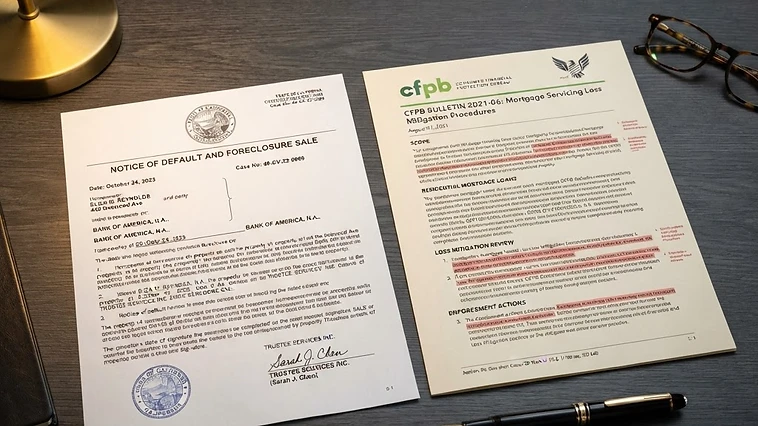 Close-up of mortgage servicing documents and foreclosure notices on a dark desk.

Procedural Defenses are based on the rules that apply to the foreclosure process. If the foreclosing party fails to follow the strict procedures required by state law, you can ask the court to dismiss the case Defenses to Foreclosure Under the Law. One of the most common procedural defenses is challenging the foreclosing party's "standing." If the bank or trust cannot produce the original promissory note or prove they have the legal right to foreclose, the court may dismiss the case. However, it is important to note that a procedural dismissal is often "without prejudice," meaning the lender can refile the lawsuit once they correct the procedural error Defenses to Foreclosure Under the Law.
Substantive Defenses are based on the specific facts of your case. This is where servicing errors and abusive practices come into play. A substantive defense argues that the foreclosure itself is fundamentally flawed or unjust. Examples include:
- The servicer failed to promptly credit your payments or credited them to the wrong account Defenses to Foreclosure Under the Law.
- The servicer overstated the amount needed to reinstate the mortgage, causing you to believe you could not afford to save your home Defenses to Foreclosure Under the Law.
- The servicer proceeded with foreclosure despite an active loan modification agreement Defenses to Foreclosure Under the Law.
How Servicing Errors Lead to Wrongful Foreclosure
Mortgage servicers handle millions of accounts, and their employees frequently make mistakes. Unfortunately, a simple clerical error on their end can result in the loss of your home.
One of the most egregious servicing abuses is "dual tracking." Dual tracking occurs when a mortgage servicer pursues a foreclosure while simultaneously negotiating with a homeowner on a loss mitigation option, such as a loan modification Defenses to Foreclosure Under the Law. Federal regulations strictly prohibit this practice. If you submit a complete loss mitigation application, the servicer must halt the foreclosure process until they have evaluated your application and provided a decision.
Furthermore, the CFPB has proposed new rules to streamline mortgage servicing for borrowers experiencing payment difficulties Rules on mortgage servicing. These proposed amendments to Regulation X aim to force servicers to be more responsive and transparent. When servicers pile up excessive, unauthorized fees or fail to adjust their records to reflect a loan modification, they are violating the terms of the mortgage and federal law Defenses to Foreclosure Under the Law.
Fighting Back: RESPA, TILA, and Your Rights
Homeowners are not powerless against abusive mortgage servicers. Federal laws provide specific mechanisms for holding servicers accountable and demanding transparency.
The Real Estate Settlement Procedures Act (RESPA) requires servicers to acknowledge and respond to written notices of error and requests for information. Under RESPA, a borrower must receive notice of a servicing transfer from their old servicer at least 15 days before the transfer takes effect, and from the new servicer within 15 days after the transfer Defenses to Foreclosure Under the Law. If your servicer ignores your Notice of Error (NOE) or Request for Information (RFI), they are violating RESPA, which can be used as leverage in your foreclosure defense.
The Truth in Lending Act (TILA) requires that a borrower receive notice when their mortgage is transferred to a new owner or assignee within 30 days of the transfer Defenses to Foreclosure Under the Law. Failure to provide this notice can complicate the new owner's ability to prove standing in a foreclosure lawsuit.
Additionally, borrowers with loans backed by the USDA, FHA, or VA have specific, enhanced rights to loss mitigation under federal law. Pointing out a violation of these specific agency guidelines can prevent a foreclosure until the lender fully complies with the law Defenses to Foreclosure Under the Law.
Why the Foreclosure Defense Survival Playbook Helps
Navigating the complex web of mortgage servicing rules, CFPB regulations, and court procedures is overwhelming for any homeowner. When you are facing the loss of your home, you cannot afford to rely on guesswork. You need a comprehensive, step-by-step guide to level the playing field against the banks and their high-priced attorneys.
This is exactly why the Foreclosure Defense Survival Playbook is an indispensable resource. This 530-page educational manual is designed specifically for homeowners who are behind on payments or already in foreclosure. It breaks down complex legal concepts into plain, understandable language.
Inside the Playbook, you will learn how to:
- Audit your mortgage documents for fatal errors and RESPA/TILA violations.
- Draft and send effective Notices of Error and Requests for Information to force your servicer to show their hand.
- Organize your evidence to prove servicing abuses, dual tracking, and lack of standing.
- Understand the rules of civil procedure and discovery so you can confidently navigate the court system.
Don't let a mortgage servicer's "abusive practices" cost you your home. Empower yourself with the knowledge to fight back. Order the Foreclosure Defense Survival Playbook today and take the first step toward saving your home and securing your financial future.


Order The Playbook
Get the Foreclosure Defense Survival Playbook
530 pages of structured, educational guidance covering mortgage documents, foreclosure procedures, evidence organization, and legal research — the same foundation this article draws from.