Foreclosure Defense
Recent CFPB Enforcement Actions Expose Ongoing Mortgage Servicing Abuses
Recent federal crackdowns and court rulings highlight a disturbing trend of illegal foreclosure practices and evidentiary failures by major mortgage servicers.

Disclaimer: The following article is for educational purposes only and does not constitute legal advice. If you are facing foreclosure, consult with a qualified attorney in your jurisdiction.
For homeowners struggling to keep up with monthly mortgage payments, the threat of foreclosure is a terrifying reality. But what happens when the very institutions tasked with managing your loan break the law? Recent news and federal enforcement actions have pulled back the curtain on a disturbing reality: mortgage servicing abuses, illegal foreclosure practices, and sloppy legal documentation are still rampant in the United States.
Despite the sweeping reforms enacted after the 2008 financial crisis, major banks and mortgage servicers continue to make devastating errors. In just the past week, reports of Consumer Financial Protection Bureau (CFPB) enforcement actions and state-level court rulings have highlighted how servicers are violating federal orders, misapplying payments, and failing to produce basic evidence in court.
For homeowners facing foreclosure, these headlines are more than just news—they are a call to action. Understanding how mortgage servicers operate, the mistakes they make, and the legal rights you possess is the first step in mounting a successful foreclosure defense.
The Latest Crackdown on Illegal Foreclosure Practices
The Consumer Financial Protection Bureau (CFPB) serves as the primary federal watchdog for the financial industry. Recently, the agency has ramped up its scrutiny of mortgage servicers that fail to follow the law. A prime example is the CFPB's action against Fay Servicing for illegal foreclosure actions, which highlights a pattern of behavior that harms vulnerable homeowners.
When a mortgage servicer violates a law enforcement order, it demonstrates a systemic failure to prioritize consumer protection. In many of these enforcement actions, the CFPB has found that servicers are moving forward with foreclosure proceedings while simultaneously telling borrowers they are being evaluated for loan modifications or other loss mitigation options. This practice is not only unethical; it is illegal under federal law.
Furthermore, enforcement actions often reveal that servicers are charging unauthorized fees, failing to properly credit payments, and ignoring homeowner requests for information. When a servicer is penalized by the CFPB, it is usually required to pay restitution to harmed consumers and overhaul its internal practices. However, for a homeowner currently in the crosshairs of an aggressive foreclosure mill, waiting for a federal agency to step in is not a viable strategy. You must learn to identify these abuses in your own case and use them as leverage in your defense.
How "Dual Tracking" and Servicing Errors Still Threaten Homeowners
One of the most egregious abuses in the mortgage servicing industry is a practice known as "dual tracking." Dual tracking occurs when a mortgage servicer moves forward with foreclosure proceedings—such as filing a complaint in court or scheduling a sheriff's sale—while simultaneously processing a homeowner's application for a loan modification or other loss mitigation assistance.
Under the Real Estate Settlement Procedures Act (RESPA) and rules enforced by the CFPB, dual tracking is strictly prohibited. If you submit a complete loss mitigation application, your servicer must halt the foreclosure process until they have fully evaluated your application and provided you with a decision. Unfortunately, recent errors and abuses by mortgage servicers show that dual tracking remains a persistent threat.
Servicing errors go far beyond dual tracking. Homeowners frequently report that their servicers have misapplied payments, placing funds into "suspense accounts" rather than crediting them toward the principal and interest. This can artificially inflate the amount the servicer claims is past due, triggering unwarranted late fees and pushing the account into default.
Additionally, servicers have been caught improperly force-placing insurance on properties that already have adequate coverage, adding thousands of dollars to the borrower's balance. If you are behind on payments, you must scrutinize every monthly statement and notice you receive. Requesting a complete payment history and comparing it against your own bank records is a critical step in uncovering these hidden errors.
Evidentiary Failures: Why Lenders Are Losing in Court
When a bank or mortgage servicer files a foreclosure lawsuit, they are the plaintiff. As the plaintiff, they bear the burden of proof. They must prove to the court that they have the legal right to foreclose, a concept known as "standing." To establish standing, the plaintiff must produce specific evidence, including the original promissory note, a valid mortgage or deed of trust, and a clear chain of assignments showing how the loan was transferred from the original lender to the current plaintiff.
Recent court decisions have shown that lenders are frequently failing to meet this burden. For example, reports indicate that Deutsche Bank splits four foreclosure rulings as timing, evidence bite lenders. In these cases, small slips regarding the timing of notices and the accuracy of servicer affidavits were enough to sink the lender's case.
 Close-up of legal affidavits and reading glasses on a dark desk under warm lighting, representing the forensic review of mortgage documents.
This is a monumental revelation for homeowners defending themselves in court. It proves that banks are not invincible. When a homeowner or their attorney demands strict proof of standing and challenges the admissibility of the bank's evidence, the cracks in the lender's case begin to show.
Often, the affidavits submitted by the servicer's employees are based on hearsay rather than personal knowledge. The employee signing the document may have never actually reviewed the business records they are swearing to. By aggressively utilizing the discovery process—demanding to see the original documents, questioning the chain of custody, and deposing the individuals who signed the affidavits—homeowners can expose these evidentiary failures and potentially have the foreclosure action dismissed.
The Ghost of Robo-Signing: Documentation Defects in 2024 and Beyond
During the height of the 2008 foreclosure crisis, the term "robo-signing" became a household word. It referred to the practice of mortgage servicer employees rapidly signing thousands of foreclosure affidavits without ever verifying the accuracy of the information contained within them. While the massive, multi-state settlements of the early 2010s were supposed to eradicate this practice, the ghost of robo-signing still haunts the judicial system today.
Recent scrutiny of foreclosure "robo-signers" and ongoing documentation problems reveal that the underlying issues were never fully resolved. Mortgages are still being bundled, securitized, and sold multiple times on Wall Street. Every time a loan changes hands, an assignment of mortgage must be properly executed and recorded.
In their rush to foreclose, servicers frequently rely on fabricated, backdated, or fraudulently executed assignments to patch holes in the chain of title. You might find that an assignment was signed by an individual claiming to be a vice president of a bank that went out of business years before the document was dated. Or, you might discover that the notary public who stamped the document's acknowledgment was not even commissioned at the time the signature allegedly took place.
These are not mere technicalities; they are fatal defects that destroy the plaintiff's legal standing. Homeowners must learn to act as forensic investigators, meticulously examining every signature, date, and corporate title on the documents filed in their case.
Your Rights Under Federal and State Foreclosure Laws
As a homeowner, you are protected by a complex web of federal and state laws designed to ensure fairness and transparency in the foreclosure process. Understanding these homeowners' legal rights before, during, and after foreclosure is essential for your survival.
First and foremost is the federal 120-day rule. Under CFPB regulations, a mortgage servicer cannot officially initiate the foreclosure process (by filing a lawsuit or recording a notice of default) until your mortgage obligation is more than 120 days delinquent. This window is designed to give you time to submit a loss mitigation application.
If you suspect your servicer has made an error—such as misapplying a payment or charging an illegal fee—you have the right to send a Notice of Error (NOE) or a Request for Information (RFI) under RESPA. The servicer is legally required to acknowledge your request within five business days and conduct a reasonable investigation, usually within 30 days. If they fail to comply, they can be held liable for damages.
Furthermore, many states require mandatory settlement conferences or mediation before a foreclosure can proceed. For instance, New York's Residential Foreclosure Actions Consumer Bill of Rights mandates that homeowners have the right to participate in a settlement conference to negotiate with the lender. You must attend these hearings, but you should never go in blind. You must arrive armed with your complete payment history, a log of all communications with your servicer, and a clear understanding of the legal defenses available to you.
Why the Foreclosure Defense Survival Playbook Helps
Facing a foreclosure lawsuit against a massive financial institution can feel like an insurmountable challenge. The banks have teams of lawyers, endless resources, and a legal system that often seems stacked in their favor. But as recent CFPB enforcement actions and court rulings prove, these institutions are deeply flawed. They make mistakes, they cut corners, and they frequently violate the law.
This is exactly why the Foreclosure Defense Survival Playbook is an absolute necessity for any homeowner fighting to save their property. This comprehensive, 530-page educational resource is designed to level the playing field. It demystifies the complex world of mortgage documents, teaching you exactly how to spot the fraudulent assignments, backdated signatures, and hearsay affidavits that lenders rely on to steal homes.
The Playbook walks you through the entire foreclosure procedure, from the initial notice of default to the intricacies of the discovery process. It provides you with the knowledge you need to organize your evidence, draft powerful Requests for Information, and conduct the legal research necessary to hold your mortgage servicer accountable.
You do not have to be a victim of servicing abuses, dual tracking, or robo-signing. By educating yourself on the rules of court procedure and the strict evidentiary standards lenders must meet, you can transform from a passive defendant into an empowered advocate for your own home. Do not let the banks win by default. Order the Foreclosure Defense Survival Playbook today, arm yourself with the knowledge to fight back, and take the first step toward securing your family's financial future.

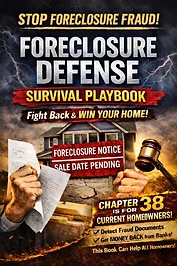
Order The Playbook
Get the Foreclosure Defense Survival Playbook
530 pages of structured, educational guidance covering mortgage documents, foreclosure procedures, evidence organization, and legal research — the same foundation this article draws from.