Foreclosure Defense
Foreclosure Defense: How CFPB Database Rollbacks Impact Your Fight
New rollbacks of the CFPB’s consumer complaint database and TILA-RESPA protections leave homeowners vulnerable to mortgage servicing abuses, making self-advocacy and education more critical than ever.

Disclaimer: The information provided in this article is strictly for educational purposes and does not constitute legal advice. If you are facing foreclosure, consult with a qualified attorney in your state.
In August 2026, the landscape of homeowner rights and mortgage oversight shifted dramatically. On August 14, 2026, the administration announced an unprecedented move to suppress the publication of consumer complaints submitted to the Consumer Financial Protection Bureau (CFPB). Just days prior, on August 10, consumer watchdog groups raised alarms regarding the CFPB’s plans to unravel decades-old Truth in Lending Act (TILA) and Real Estate Settlement Procedures Act (RESPA) protections.
For homeowners who are behind on payments or currently facing foreclosure, these developments are critical. The CFPB complaint database has historically been the primary public warning system for mortgage fraud, servicing abuses, and predatory lending. Without this public transparency, homeowners must become their own best advocates. If you are fighting to save your home, understanding these regulatory shifts—and how to build a robust foreclosure defense in the face of them—is no longer just an option; it is an absolute necessity.
The August 2026 Shift in Homeowner Protections
For more than a decade, the CFPB’s consumer complaint database served as a powerful tool for public accountability. With over 17 million complaints filed regarding credit reporting, mortgage providers, and student loan servicers, the database forced financial institutions to address grievances on the public record. Borrowers who experienced improper dual tracking, unrecorded assignments, or robo-signing could report their mortgage servicer, giving the company two weeks to publicly respond.
The August 14, 2026 decision to suppress this information shields financial firms from public scrutiny. While consumers can still submit complaints, the narratives and specific allegations of abuse will no longer be available for the public, journalists, or foreclosure defense advocates to analyze. This means that systemic mortgage servicing abuses—such as failing to process loss mitigation applications, misapplying payments, or charging illegal junk fees—will be much harder to identify on a national scale.
When the government stops publishing data on corporate misconduct, the burden of uncovering and proving that misconduct falls entirely on the homeowner.
The Unraveling of TILA and RESPA Protections
Adding to the complexity of the current regulatory environment is the ongoing effort to soften the TILA-RESPA Integrated Disclosure (TRID) rules. Originally adopted to help borrowers understand the confusing and expensive process of securing a loan, TRID rules were designed to prevent lenders from hiding unfair charges, inflated prices, and risky loan terms.
In early August 2026, groups like the National Consumer Law Center (NCLC) submitted warnings that the CFPB’s new supervisory priorities could open the door for disreputable lenders to prey on consumers. Specifically, consumer advocates are concerned about the "rules of rescission," which give borrowers a three-day window to cancel a mortgage without penalty.
For homeowners already in foreclosure, TILA and RESPA violations are powerful tools. When lenders fail to properly disclose loan terms or violate RESPA guidelines regarding loss mitigation and mortgage servicing, homeowners can use these failures as substantive defenses. If these federal rules are weakened, or if the CFPB shifts to a "humility in supervision" model that relies on banks self-reporting their errors, homeowners lose vital statutory leverage.
 Mortgage assignment documents and reading glasses under a warm desk lamp, representing the forensic review of foreclosure paperwork.
What This Means for Homeowners Facing Foreclosure
If you are behind on your mortgage, the rollback of federal oversight means you cannot rely on regulatory agencies to catch your servicer's mistakes. Mortgage servicers handle trillions of dollars in residential loans, and their systems are notoriously prone to error.
Recent enforcement actions leading up to these rollbacks highlighted exactly how bad these errors can be. Servicers have been caught illegally charging property inspection fees, sending deceptive notices, and initiating foreclosure proceedings while borrowers were actively in loss mitigation review—a practice known as "dual tracking." Furthermore, issues with assignments—the legal transfer of the mortgage from one bank to another—continue to plague the industry. Lenders frequently lose original promissory notes, forge endorsements, or rely on inaccurate affidavits.
Without a public CFPB database to track which banks are routinely committing these offenses, you must meticulously audit your own mortgage documents. Every statement, every fee, and every piece of correspondence must be reviewed for accuracy. If your servicer claims you owe $10,000 in arrears, but their math includes prohibited late fees or forced-placed insurance you did not need, you must have the knowledge and evidence to challenge them in court.
Defending Yourself: Evidence, Discovery, and Standing
In a landscape with diminished federal enforcement, the discovery process in civil litigation becomes your most powerful weapon. Foreclosure is a legal proceeding, and the bank must prove they have the legal right—known as "standing"—to take your home.
Challenging Standing and Assignments
To foreclose, the bank must usually prove it holds the original promissory note and a valid assignment of the mortgage. Because loans are frequently bought, sold, and securitized into complex trusts, the paperwork often gets lost or botched. Homeowners can demand to see the original "wet-ink" signature on the promissory note. If the bank produces a note with an undated, stamped endorsement, or an assignment signed by a known "robo-signer" (an employee who signs thousands of documents without verifying their accuracy), you can challenge the validity of the foreclosure action.
Utilizing the Discovery Process
Do not take the bank’s word for it. Through formal discovery—such as Requests for Production of Documents, Interrogatories, and Requests for Admission—you can legally force the mortgage servicer to hand over their internal records. This includes payment histories, servicing logs, and proof of their compliance with whatever RESPA loss mitigation rules remain in effect. Often, the simple act of aggressively pursuing discovery can bring a foreclosure mill to a halt, as they realize you are not going to be an easy default judgment.
Examining Procedural Defenses
Banks are required to follow strict pre-foreclosure procedures. In many states, this includes sending a specific "Notice of Default" or "Right to Cure" letter within a certain timeframe. If the lender fails to send this notice, sends it to the wrong address, or fails to state the exact amount required to cure the default, the court may dismiss the foreclosure action. While a dismissal without prejudice allows the bank to refile, it buys the homeowner valuable time to reorganize their finances or negotiate a modification.
Avoiding Mortgage Fraud and Assistance Scams
As government agencies step back from aggressive public enforcement, fraudulent actors are stepping up to fill the void. Homeowners facing foreclosure are incredibly vulnerable, making them prime targets for mortgage fraud and assistance scams.
Recent cases highlight the severity of this issue. In mid-2026, the California Department of Financial Protection and Innovation (DFPI) and the Federal Trade Commission (FTC) secured nearly $3 million in refunds for victims of a massive mortgage relief scheme. Companies operating under names like Golden Home Services and Home Matters USA falsely promised to reduce homeowners' mortgage payments and prevent foreclosure. Instead, they convinced vulnerable borrowers to send their monthly payments directly to the scammers, resulting in lost equity and accelerated evictions.
To protect yourself:
- Never pay upfront fees: It is illegal for a company to charge you an upfront fee for foreclosure relief or loan modification services.
- Do not transfer your deed: Scammers often tell homeowners to sign over the deed to their property under the guise of a "rescue" operation. This will almost certainly result in the loss of your home.
- Communicate directly with your servicer: Never send your mortgage payment to a third party claiming they will handle your lender. Always pay your servicer directly.
- Seek legitimate help: Use HUD-approved housing counselors who offer free, legitimate assistance to distressed borrowers.
When the system is stacked against you, and public warning systems like the CFPB complaint database are taken offline, education is your best defense against both predatory banks and opportunistic scammers.
Why the Foreclosure Defense Survival Playbook Helps
The sudden rollback of federal consumer protections in August 2026 proves one undeniable truth: no one is coming to save your home but you. To successfully fight back, you need more than just a basic understanding of your rights; you need a comprehensive, step-by-step strategy to hold banks accountable when the government will not.
This is exactly where the Foreclosure Defense Survival Playbook becomes an indispensable tool. As a massive 530-page educational resource, the Playbook is specifically designed for homeowners who are behind on payments or already embroiled in a foreclosure lawsuit.
Here is how the Playbook equips you for the fight:
- Decoding Mortgage Documents: Learn how to read your promissory note, mortgage, and assignments to spot forged endorsements, robo-signing, and chain-of-title defects.
- Mastering Court Procedure: Understand how to answer a foreclosure complaint, file motions to dismiss, and navigate the complex rules of civil procedure without being intimidated by bank lawyers.
- Executing Aggressive Discovery: Get access to strategies for demanding internal servicing logs, payment histories, and pooling and servicing agreements (PSAs) that banks desperately want to keep hidden.
- Organizing Your Evidence: Learn forensic techniques for auditing your own payment history to catch illegal junk fees, misapplied payments, and servicing abuses that violate TILA and RESPA.
- Pro Se Litigation Tactics: For those who cannot afford an attorney, the Playbook offers a deep dive into legal research, helping you advocate for yourself effectively and confidently.
With federal agencies suppressing data and loosening regulations on financial giants, you must level the playing field yourself. Do not let a mortgage servicer illegally take your property simply because they assume you do not know the rules. Arm yourself with the knowledge required to expose their errors, challenge their standing, and protect your family’s most valuable asset.
Order your copy of the Foreclosure Defense Survival Playbook today, and take the first step in reclaiming control over your home and your financial future.

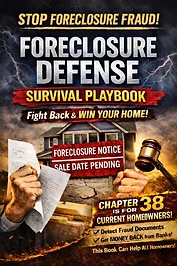
Order The Playbook
Get the Foreclosure Defense Survival Playbook
530 pages of structured, educational guidance covering mortgage documents, foreclosure procedures, evidence organization, and legal research — the same foundation this article draws from.