Mortgage Servicing
CFPB Cracks Down on Mortgage Servicing Abuses: What Homeowners Facing Foreclosure Need to Know
Recent federal crackdowns have exposed widespread mortgage servicing abuses, including illegal junk fees and deceptive loss mitigation practices. Learn how to spot these errors and defend your home.
Disclaimer: The following article is for educational purposes only and does not constitute legal advice. If you are facing foreclosure, you should consult with a qualified attorney in your jurisdiction.
When you fall behind on your mortgage payments, the sheer volume of letters, notices, and legal threats from your bank or mortgage servicer can be overwhelming. For many homeowners, the assumption is that the bank's numbers are always right and that the foreclosure process, while devastating, is being handled legally. However, recent federal investigations and enforcement actions reveal a very different reality. Mortgage servicers frequently make catastrophic errors, charge illegal fees, and violate federal laws designed to protect homeowners.
Recently, the Consumer Financial Protection Bureau (CFPB) has launched a massive crackdown on mortgage servicing abuses. From assessing illegal "junk fees" to botching loss mitigation applications, these servicing errors are actively pushing vulnerable homeowners closer to losing their homes. If you are currently behind on payments or actively fighting a foreclosure, understanding these recent enforcement actions and proposed rule changes is critical to your defense strategy.
The Recent Crackdown on Mortgage Servicing Abuses
In its recent Supervisory Highlights and subsequent enforcement actions, the CFPB has exposed a disturbing trend of unfair, deceptive, and abusive acts or practices (UDAAP) within the mortgage servicing industry. Mortgage servicers are the companies that handle the day-to-day management of your loan—collecting payments, managing escrow accounts, and processing loan modification requests. When you default, they are also the entities that initiate foreclosure proceedings.
The CFPB's recent examinations found that many servicers are actively violating the Real Estate Settlement Procedures Act (RESPA) and the Truth in Lending Act (TILA). One of the most egregious violations involves the assessment of illegal fees. Examiners discovered that servicers were charging homeowners for unnecessary property inspections following a delinquency, even when such inspections were explicitly prohibited by investor guidelines (such as those set by Fannie Mae).
Furthermore, servicers were caught assessing late fees that exceeded the amounts allowed in the original loan agreements. In some cases, these late fees were charged even after consumers had entered into loss mitigation agreements that were supposed to pause such penalties. For a homeowner already struggling to make ends meet, these illegal "junk fees" artificially inflate the default amount, making it exponentially harder to reinstate the loan and save the home.
How "Junk Fees" Accelerate the Foreclosure Process
To understand why the CFPB is targeting junk fees, you have to look at the mechanics of a foreclosure. When a servicer files a Notice of Default or a foreclosure complaint, they must state the exact amount required to cure the default. This reinstatement amount is supposed to be a strict calculation of missed principal, interest, and allowable escrow advances.
However, when a servicer illegally pads your account with unauthorized property inspection fees, inflated corporate advance fees, and improper late charges, the reinstatement amount skyrockets. A homeowner who might have been able to borrow $5,000 from family to save their home suddenly finds themselves facing a fabricated $9,000 reinstatement demand.
 Magnifying glass inspecting mortgage servicing documents and foreclosure notices

Recent enforcement actions, including multi-million dollar consent orders against major servicers for failing to properly service loans and ignoring homeowner requests for payoff statements, highlight how these accounting "errors" are rarely in the homeowner's favor. By auditing your mortgage statements and demanding a complete transaction history, you can often uncover these illegal fees. Challenging the accuracy of the debt is a fundamental component of foreclosure defense, as a bank cannot foreclose based on a fraudulently inflated default amount.
The Danger of Dual Tracking and Loss Mitigation Errors
Another major focus of recent federal scrutiny is the mishandling of loss mitigation applications. Loss mitigation refers to the process where a homeowner applies for a loan modification, forbearance, or other alternative to foreclosure. Under federal law (specifically RESPA Regulation X), once a homeowner submits a complete loss mitigation application, the servicer is generally prohibited from moving forward with a foreclosure sale—a practice known as "dual tracking."
Despite these clear rules, the CFPB found that servicers are still sending deceptive loss mitigation eligibility notices to consumers. In some instances, written notices failed to provide a deadline for accepting or rejecting loss mitigation offers, leaving homeowners in a state of limbo while the foreclosure clock continued to tick. Other servicers failed to properly document their attempts to establish live contact with delinquent borrowers, a strict requirement under RESPA.
To combat this, the CFPB has proposed new rules to streamline the mortgage servicing process. The proposed framework aims to reduce the rigid paperwork requirements that often cause applications to be deemed "incomplete," thereby allowing servicers to proceed with foreclosure. Under the new proposals, if a borrower requests help more than 37 days before a foreclosure sale, they would enter a "loss mitigation review cycle" that effectively pauses foreclosure procedural safeguards until the loan is brought current or all options are exhausted. While these rules are still being finalized, they underscore a critical point for homeowners: the loss mitigation process is fraught with servicer errors, and you must meticulously document every interaction, application, and letter you send to your servicer.
Spotting Errors in Your Mortgage Statements and Notices
If you are facing foreclosure, you cannot afford to take your mortgage servicer's word for anything. The recent federal findings prove that servicers routinely make mistakes that violate your rights. To protect yourself, you must learn how to scrutinize your mortgage documents like a forensic auditor.
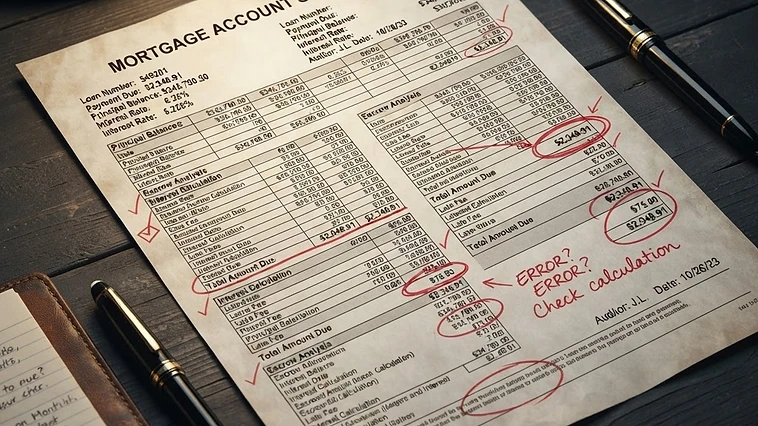
First, review every monthly mortgage statement you receive. Look for unexplained fees, such as "property preservation fees," "BPO fees" (Broker Price Opinions), or vague "corporate advances." Compare the late fees being assessed against the specific percentage allowed in your original Promissory Note.
Second, utilize your rights under RESPA. You have the right to send a Qualified Written Request (QWR) or a Notice of Error (NOE) to your servicer. These formal, legally binding letters require the servicer to investigate your account, correct errors, and provide you with specific documents, such as your complete payment history and the identity of the current owner of your loan. If the servicer fails to respond adequately within the federally mandated timeframes, they may be liable for damages, and their failure can be used as powerful leverage in your foreclosure defense case.
Finally, keep a detailed log of all communications. Write down the date, time, and name of every representative you speak with regarding your loan modification. Save every letter, email, and fax confirmation. When a servicer attempts to dual-track you by scheduling a foreclosure sale while you are under review for a modification, your meticulously organized evidence will be your strongest weapon in court.
Why the Foreclosure Defense Survival Playbook Helps
Navigating the treacherous waters of mortgage servicing abuses, junk fees, and dual tracking is nearly impossible without the right knowledge. The banks have teams of lawyers and automated systems designed to push foreclosures through as quickly as possible. To fight back, you need to understand the rules of the game better than they do.
This is exactly why the Foreclosure Defense Survival Playbook is an indispensable resource for any homeowner behind on payments. This comprehensive, 530-page educational guide breaks down complex mortgage documents, foreclosure procedures, and federal servicing laws into plain, actionable language.
The Playbook teaches you step-by-step how to audit your mortgage statements for the exact illegal junk fees the CFPB is currently cracking down on. It provides detailed instructions on how to draft and send effective RESPA Qualified Written Requests and Notices of Error to force your servicer to hand over the evidence you need. Furthermore, it guides you through the process of organizing your evidence, conducting legal research, and understanding court procedures so you can confidently challenge the bank's standing and the accuracy of their claims.
Don't let mortgage servicer abuses cost you your home. Equip yourself with the knowledge to spot their errors, hold them accountable, and mount a formidable defense. Order your copy of the Foreclosure Defense Survival Playbook today and take the first step toward taking back control of your home and your financial future.


Order The Playbook
Get the Foreclosure Defense Survival Playbook
530 pages of structured, educational guidance covering mortgage documents, foreclosure procedures, evidence organization, and legal research — the same foundation this article draws from.