Mortgage Documents
The Hidden Risks in Your Mortgage Paperwork: Why Current Homeowners Must Audit Their Files
Even if you pay your mortgage on time, hidden loan document errors and recent AI-driven mortgage fraud could jeopardize your home's title and your ability to refinance.
Disclaimer: The information provided in this article is strictly for educational purposes and does not constitute legal advice. If you have concerns about your mortgage documents or property title, please consult a qualified attorney in your jurisdiction.
Many homeowners operate under a dangerous assumption: if you pay your mortgage on time every month, your loan file must be in perfect order. You receive your monthly statements, you make your payments, and your balance slowly decreases. However, the reality of the modern mortgage industry is far more complex and, unfortunately, far more prone to error and deception.
Recent investigations and federal court cases have revealed a disturbing trend of fabricated documents, forged signatures, and systemic lender negligence. Whether you are planning to refinance, sell your home, or simply want peace of mind, conducting a thorough mortgage document review is no longer just for homeowners facing foreclosure. It is a vital protective measure for every current homeowner.
In this comprehensive guide, we will explore the recent surge in mortgage fraud, the hidden loan document errors that could be lurking in your file, and why performing a personal mortgage audit is essential before you sign any new refinance paperwork.
The 2026 Surge in AI-Driven Mortgage Fraud
The landscape of mortgage fraud is evolving rapidly, driven by advancements in technology that make fabricating documents easier than ever. A recent report from National Mortgage News highlighted a major federal bank fraud case that exposes the severe vulnerabilities in lender underwriting processes. In this case, fraudsters utilized artificial intelligence and digital manipulation to fabricate pay stubs, W-2s, and employment verification documents for borrowers.
What makes this case particularly alarming for the average homeowner is not just the sophistication of the fraud, but the failure of the lenders to catch it. The fabricated documents were forwarded to major lenders who completely failed to detect the anomalies, resulting in the wrongful origination of hundreds of thousands of dollars in home financing backed by Fannie Mae, Freddie Mac, and the FHA.
Furthermore, the industry is currently scrambling to implement new fraud detection technologies. In October 2026, financial technology companies began rolling out advanced AI detection tools specifically designed to catch tampered bank statements and tax forms that human underwriters are missing.
But how does this affect you, the honest homeowner? If lenders are routinely failing to catch blatant AI-generated fraud at origination, it begs the question: what else are they missing? If their quality control is this porous, the likelihood of administrative errors, lost assignments, and improper recording in your own mortgage file is exceptionally high. When you go to refinance, these hidden defects can suddenly surface, causing massive delays or even threatening your legal claim to your property.
Why Your Refinance Paperwork Might Be Flawed
When you decide to refinance your home to take advantage of better interest rates or to pull out equity, you are essentially paying off your old mortgage and creating a new one. This process requires a pristine chain of title. The new lender needs absolute certainty that the old lender has the legal right to release the lien on your property.
This is where a routine mortgage document review often uncovers a nightmare. During the life of a typical mortgage, the loan is often sold, transferred, or securitized multiple times. The servicing rights might change hands three or four times in a single decade. Each of these transfers requires specific legal documents—known as assignments—to be properly executed, notarized, and recorded in your local county land records.
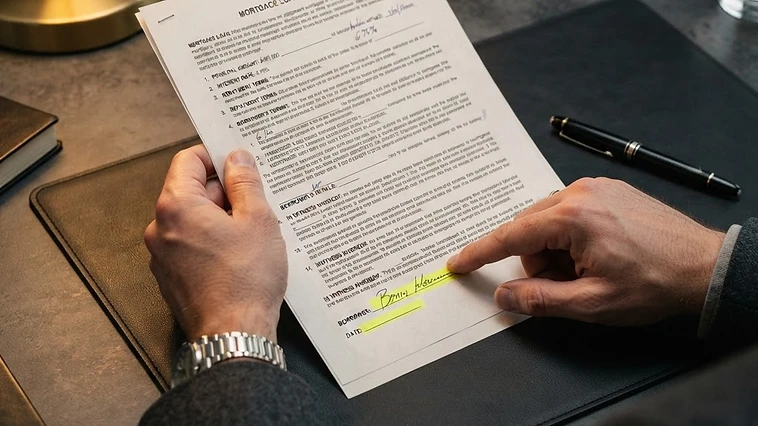 Close up of hands reviewing mortgage refinance paperwork for loan document errors.

Unfortunately, the rush to transfer these assets often leads to sloppy paperwork. It is incredibly common for assignments to be drafted years after the actual sale of the loan, sometimes by individuals who lack the legal authority to sign them (a practice notoriously known as "robo-signing"). If your refinance paperwork relies on a broken chain of title, your new title company may refuse to issue a title insurance policy, effectively killing your refinance dead in its tracks.
Even worse, if you unknowingly sign refinance paperwork that rolls over fraudulent fees, improper principal balances, or legally defective liens, you are legally binding yourself to those errors. You are essentially validating the previous lender's mistakes and waiving your right to challenge them later.
Common Loan Document Errors Hiding in Plain Sight
If you are current on your payments, you might think your file is immune to the chaos that plagued the foreclosure crisis. However, a detailed mortgage audit of performing loans frequently reveals the exact same structural defects. Here are the most common loan document errors you need to look for:
1. Missing or Unrecorded Assignments
When your loan is sold from Lender A to Lender B, an Assignment of Mortgage (or Deed of Trust) must be recorded in the county records. If Lender B then sells it to Lender C, another assignment is required. Often, lenders skip recording these intermediate transfers to save on county filing fees, creating a "gap" in your title. If Lender C tries to release your lien when you refinance, the county records will show that Lender A still owns the property.
2. MERS and Servicing Disclosure Issues
The Mortgage Electronic Registration Systems (MERS) was created by the banking industry to bypass county recording fees. MERS acts as a "nominee" for the actual lender. However, the legal authority of MERS to assign mortgages has been heavily litigated. If your mortgage paperwork lists MERS, you must carefully scrutinize who actually owns your promissory note versus who is claiming the right to collect your payments. Discrepancies here are a massive red flag.
3. Notary and Signature Irregularities
Take a close look at the signatures on your closing documents and any subsequent assignments. Are the dates correct? Was the notary commission actually valid on the date the document was stamped? In many cases of mortgage fraud, documents are backdated, or signatures are forged by loan closing services trying to expedite the process. The Financial Crimes Enforcement Network (FinCEN) has repeatedly warned about loan closing services forging applicants' signatures or failing to properly record mortgages in property land records.
4. Predatory Refinance and Hidden Fees
If you have refinanced in the past, your current principal balance might be inflated by illegal junk fees, improper escrow calculations, or unauthorized property inspection fees. Servicers often quietly add these fees to your account balance. Because you are paying on time, you never notice the slight inflation of your principal until you request a payoff statement for your next refinance.
How to Conduct a Basic Mortgage Document Review
You do not need to wait for a lawyer to start looking into your own file. Every homeowner has the right to demand and review their mortgage documents.
First, you should request a complete copy of your collateral file from your current mortgage servicer. Under the Real Estate Settlement Procedures Act (RESPA), you can send a Qualified Written Request (QWR) or a Request for Information (RFI) to your servicer demanding copies of your original promissory note, the mortgage or deed of trust, all assignments, and a complete life-of-loan payment history.
Second, you must cross-reference the documents your servicer provides with the public records in your county. Visit your local county recorder's office (many have online portals now) and search for your property address or your name. Download every single document recorded against your property since the day you bought it.
Compare the county records to the servicer's records. Does the servicer claim that a specific trust owns your loan, but the county records show no assignment to that trust? Does the signature of the bank vice president on your assignment look completely different from the signature of the same person on another document? These discrepancies are the foundation of a professional mortgage audit and are the exact anomalies that indicate your title may be clouded.
Why Auditing Your Mortgage Paperwork Matters
It is a dangerous misconception that only homeowners in default need to worry about the accuracy of their loan files. The reality is that the mortgage industry is a high-volume, low-precision machine. Errors, missing documents, and outright mortgage fraud are baked into the system.
Even if you are perfectly current on your payments, you must audit your mortgage paperwork before you attempt to refinance, sell your home, or pass your property on to your heirs. Discovering a forged assignment or a missing title link while you are under contract to sell your home can result in the loss of the sale and thousands of dollars in emergency legal fees to quiet the title. By conducting a mortgage document review now, while you are not under financial distress, you take control of your property rights.
This is exactly why the Foreclosure Defense Survival Playbook is an indispensable resource for every homeowner, not just those facing litigation. The Playbook provides a deep, step-by-step education on how to read your mortgage documents, how to spot the subtle signs of forgery and robo-signing, and how to organize your evidence like a forensic auditor. It teaches you the mechanics of securitization, the rules of evidence, and how to hold your lender accountable for the documents they hand you.
Do not wait for a title company to tell you your refinance is denied because of a bank's sloppy paperwork from five years ago. Protect your greatest asset. Order the Foreclosure Defense Survival Playbook today, learn how to audit your own file, and ensure that your piece of the American Dream is built on a foundation of accurate, legally sound documents.


Order The Playbook
Get the Foreclosure Defense Survival Playbook
530 pages of structured, educational guidance covering mortgage documents, foreclosure procedures, evidence organization, and legal research — the same foundation this article draws from.