Mortgage Documents
The Hidden Dangers in Your Mortgage Documents: Why Current Homeowners Must Audit Their Files
Even if you are current on your payments, hidden errors and fraud in your mortgage paperwork can derail a future refinance or sale.
Disclaimer: The following article is for educational purposes only and does not constitute legal advice. Always consult with a qualified attorney regarding your specific legal situation.
When you pay your mortgage on time every month, it is easy to assume that your loan file is in perfect order. You receive your monthly statement, you make your payment, and your balance slowly decreases. However, the reality of the modern mortgage industry is far more complex and, unfortunately, far more prone to errors. For current homeowners who are considering refinancing, reviewing their mortgage paperwork, or simply checking whether their loan documents are accurate, a proactive mortgage document review is essential. Hidden loan document errors, title defects, and even sophisticated mortgage fraud can lurk in the files of perfectly current borrowers, threatening their financial security and complicating future transactions.
The Rising Threat of Mortgage Fraud and Fake Documents
Recent developments in the mortgage industry highlight exactly why homeowners cannot afford to be complacent about their paperwork. The rise of artificial intelligence has made it easier than ever for bad actors to fabricate documents, leading to a surge in fraudulent activities that can entangle innocent properties and borrowers. According to recent reporting, federal authorities have been cracking down on schemes where falsified documents were used to deceive banks into issuing fraudulent loans Mortgage fraud case shows AI's fake-document risk. In these cases, conspirators fabricated pay stubs and employment records, pushing through loans that were eventually guaranteed by government-sponsored enterprises.
While these specific cases often involve fraud at the origination level by third parties, they underscore a critical vulnerability in the system: lenders and servicers frequently process, approve, and record documents that contain severe inaccuracies. If banks can be fooled by AI-generated pay stubs, they can certainly make administrative errors when recording your deed, transferring your mortgage, or applying your payments. Furthermore, investigations into multifamily lending have revealed instances where investors provided fake documents to lenders and Fannie Mae, resulting in the origination of massive fraudulent mortgages Fannie Finds Fraud in Multifamily Lending - Multi-Housing News. The lesson for the everyday homeowner is clear: the institutions handling your largest financial asset are not infallible, and the burden of verifying document accuracy ultimately falls on you.
Why Current Homeowners Need a Mortgage Audit
Many homeowners believe that a mortgage audit is only necessary if they are facing foreclosure or have fallen behind on their payments. This is a dangerous misconception. Conducting a thorough mortgage document review while you are current on your payments is one of the smartest financial moves you can make. When you decide to refinance to take advantage of better interest rates or to pull equity from your home, your new lender will scrutinize your property's title and your existing loan documents.
If there are unreleased liens, missing signatures, or defective assignments in your chain of title, your refinance paperwork could be delayed or denied entirely. Title defects are incredibly common; they can include old, unreleased mortgages from previous owners, errors in the public record, or missing notary stamps Defects in Titles tor Real Estate and the Remedies. By auditing your documents now, you can identify and resolve these issues before they become a crisis.
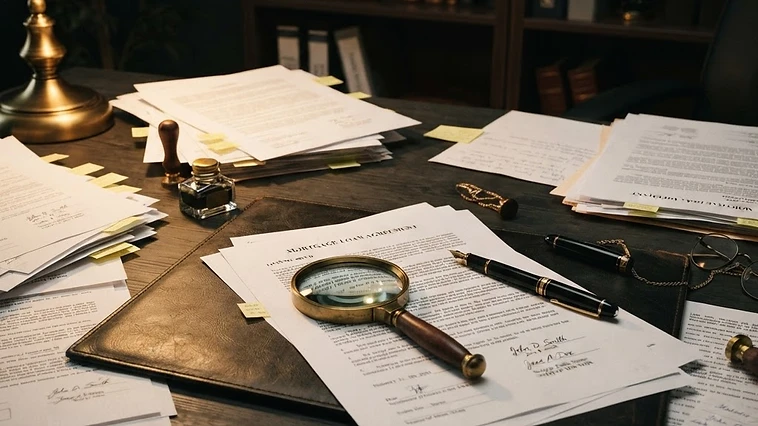
 Close up of hands reviewing mortgage refinance paperwork under a warm gold desk lamp.

Common Loan Document Errors to Look For
When you sit down to review your mortgage paperwork, you are looking for specific irregularities that could cloud your title or invalidate the lender's claims. Some of the most frequent loan document errors include:
- Missing or Fraudulent Signatures: Ensure that all documents, especially the promissory note and the deed of trust, contain your actual signature and have not been altered.
- Notary Irregularities: Check the notary acknowledgments. Are the dates correct? Was the notary commission valid at the time of signing?
- MERS and Assignment Problems: The Mortgage Electronic Registration Systems (MERS) is frequently involved in the transfer of mortgages. However, assignments of the mortgage from one entity to another are often drafted hastily, sometimes by "robo-signers," leading to broken chains of title.
- Inaccurate Principal Balances or Interest Rates: Compare your original closing disclosures with your current statements to ensure the servicer is applying your payments correctly and calculating interest according to the terms of your note.
- Unreleased Prior Mortgages: If you have refinanced in the past, ensure that the previous lender properly recorded a satisfaction or release of mortgage in the county land records.
The Dangers of Predatory Refinance Practices
As you prepare your refinance paperwork, you must also be on guard against predatory lending practices. Predatory lenders often target homeowners who have built up substantial equity, offering refinance deals that seem attractive on the surface but are loaded with hidden fees, exorbitant closing costs, or terms that strip the homeowner of their equity.
By understanding your current mortgage documents inside and out, you establish a baseline. You will know exactly what your current terms are, making it much easier to spot a bad deal when reviewing new refinance paperwork. Knowledge is your best defense against predatory practices and mortgage fraud.
Why Auditing Your Mortgage Paperwork Matters
Even if you have never missed a payment, the integrity of your mortgage file is paramount. Auditing your mortgage paperwork matters because it protects your legal rights, secures your property's title, and ensures that you are not a victim of institutional negligence or outright fraud. Whether you are preparing for a routine refinance or simply want peace of mind, you must verify that the documents a lender or servicer handed you are legally sound and factually accurate.
This is exactly why the "Foreclosure Defense Survival Playbook" is an indispensable resource for every homeowner, not just those in distress. This comprehensive 530-page educational book teaches you how to read complex mortgage contracts, understand the chain of title, and spot the hidden fraud, errors, and defects that run rampant in the mortgage industry. By learning the secrets of evidence organization and legal research outlined in the Playbook, you can confidently audit your own files, protect your home's equity, and ensure your refinance goes smoothly. Don't wait for a problem to arise—order the Foreclosure Defense Survival Playbook today and take control of your financial future.


Order The Playbook
Get the Foreclosure Defense Survival Playbook
530 pages of structured, educational guidance covering mortgage documents, foreclosure procedures, evidence organization, and legal research — the same foundation this article draws from.