Mortgage Documents
The Hidden Dangers in Your Mortgage Documents: Why Current Homeowners Must Audit Their Files
Recent reports show a massive spike in refinance fraud and document forgery. Learn why auditing your mortgage paperwork is essential even if you are current on your payments.
Disclaimer: The following article is for educational purposes only and does not constitute legal advice. If you have specific legal questions regarding your mortgage or real estate transactions, please consult a qualified attorney.
When you make your mortgage payments on time every month, it is easy to assume that everything behind the scenes is functioning perfectly. You trust that your lender recorded the deed correctly, that your title is clear, and that your refinance paperwork is free of errors. However, recent industry reports and enforcement actions reveal a troubling reality: the mortgage industry is currently facing a massive surge in document fabrication, refinance fraud, and title defects.
For current homeowners who are considering refinancing, or simply want to ensure their property rights are secure, conducting a thorough mortgage document review is no longer just a good idea—it is an absolute necessity. Even if you are not behind on payments, hidden loan document errors and fraudulent activities can jeopardize your homeownership, complicate future sales, and lead to incurable title defects.
The Alarming Rise in Refinance Fraud and Forgery
Many homeowners believe that fraud only happens during the initial purchase of a home or when a borrower defaults. However, recent data indicates that refinance transactions are increasingly becoming the primary target for sophisticated fraud schemes. According to a recent industry study, fraud and forgery claims tied to mortgage refinances have surged, now representing over 40% of all title insurer losses and expenses Refinance fraud and forgery claims soar, driving up title insurance losses.
The average cost of these fraud and forgery claims on refinances has climbed to a staggering $207,000, which is nearly seven times higher than other claim types. What makes this trend particularly dangerous for the average homeowner is that these issues often cannot be detected through a simple public records search. Fraudsters are exploiting the digital closing process, forging warranty and quitclaim deeds, and executing phantom sales that effectively transfer the property title without the true homeowner's knowledge.
If you are preparing to sign new refinance paperwork, you must be vigilant. A routine mortgage audit of your existing documents can help you verify that your current lender actually holds the valid note and that no fraudulent liens or forged deeds have been attached to your property's title.
How AI is Supercharging Mortgage Fraud
The landscape of mortgage fraud has evolved rapidly with the advent of artificial intelligence. It is no longer just about a rogue broker slipping an extra fee into a closing disclosure. Today, bad actors are using generative AI to create highly convincing synthetic identities and fabricated documents.
Recent reports highlight how much easier it has become to create false documents today, given the rise of artificial intelligence Mortgage fraud case shows AI's fake-document risk. Fraudsters can generate convincing paystubs, bank statements, and even legal property records in minutes using widely available software. This document fabrication fraud can lead to loans being originated based on falsified collateral documents, which ultimately pollutes the chain of title Mortgage Fraud: Emerging Risks, Mitigation Strategies.
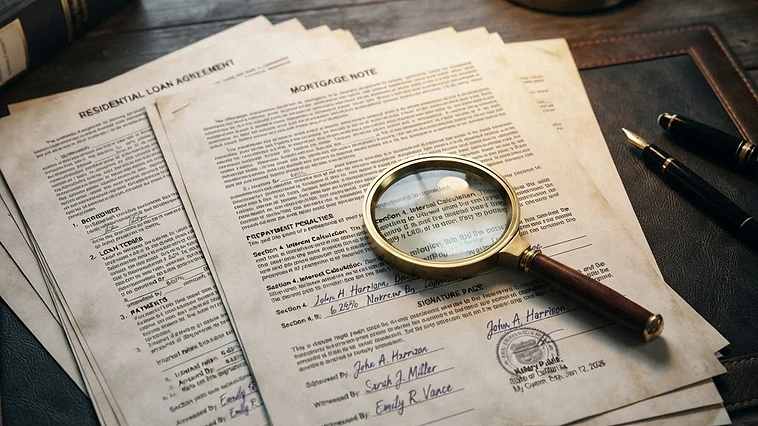
 Hands reviewing mortgage refinance paperwork on a dark desk with a gold pen.

For the current homeowner, this means that the systems designed to protect your property records are under unprecedented attack. If a fraudster uses synthetic identity theft to take out a home equity line of credit (HELOC) or a fraudulent refinance in your name, the resulting title defects can be nearly impossible to cure without extensive legal intervention. This is why a proactive mortgage document review is critical to catching these anomalies before they result in a catastrophic loss of equity.
Common Loan Document Errors to Watch For
Even without malicious intent, the sheer volume of paperwork involved in mortgage servicing and refinancing leads to rampant loan document errors. When loans are sold and transferred between servicers, critical documents are frequently lost, misfiled, or improperly endorsed.
Federal investigations into mortgage loan fraud have repeatedly uncovered systemic failures in how lenders handle paperwork. Common issues include loan closing services failing to record the mortgage in property land records, and prior lenders failing to release home equity loans after receiving a payoff Mortgage Loan Fraud. This can cause a new lender's loan to have a subordinate position, or leave the homeowner with a clouded title that prevents them from selling or refinancing the property.
During your mortgage audit, you should specifically look for:
- Missing Signatures and Notary Irregularities: Ensure that all documents, especially the deed of trust and the promissory note, are properly signed, dated, and notarized.
- Unrecorded Assignments: If your loan has been sold, there should be a clear, recorded assignment of the mortgage in your county's land records. Breaks in the chain of title are a massive red flag.
- Unreleased Liens: If you have previously refinanced or paid off a HELOC, verify that the prior lender actually filed a release or satisfaction of mortgage.
- Inaccurate Servicing Disclosures: Check your periodic statements against your original closing disclosures to ensure your interest rate, escrow calculations, and principal balances are accurate.
The Importance of a Proactive Mortgage Audit
You do not need to be facing foreclosure to benefit from a comprehensive mortgage audit. In fact, the best time to review your mortgage paperwork is when you are current on your payments and not under the immediate threat of losing your home.
By taking the time to scrutinize your refinance paperwork and original loan documents, you take control of your financial security. You can identify missing assignments, spot predatory lending terms that were hidden in the fine print, and ensure that your title is clear of any fraudulent claims or unreleased liens. If you do discover loan document errors, you have the time and leverage to demand corrections from your servicer or title company before those errors derail a future financial transaction.
Why Auditing Your Mortgage Paperwork Matters
Even if you have never missed a payment, the integrity of your homeownership relies entirely on the accuracy of the documents sitting in a lender's file. As we have seen from recent surges in refinance fraud and AI-generated document fabrication, assuming your paperwork is flawless is a risk you cannot afford to take. Auditing your mortgage paperwork matters because it is the only way to protect yourself against hidden title defects, unrecorded liens, and systemic servicing errors that could cost you tens of thousands of dollars.
This is exactly why the Foreclosure Defense Survival Playbook is an essential resource for every homeowner, not just those in distress. This comprehensive 530-page guide teaches you step-by-step how to conduct your own mortgage document review. You will learn how to decode complex refinance paperwork, spot the telltale signs of mortgage fraud, and identify the exact loan document errors that lenders hope you will never notice. Do not wait until you are trying to sell your home or facing an unexpected financial hardship to find out your title is clouded. Order the Foreclosure Defense Survival Playbook today, and empower yourself with the knowledge to audit your files, demand accuracy, and protect your most valuable asset.


Order The Playbook
Get the Foreclosure Defense Survival Playbook
530 pages of structured, educational guidance covering mortgage documents, foreclosure procedures, evidence organization, and legal research — the same foundation this article draws from.