Mortgage Documents
The Hidden Fraud in Your Mortgage File: Why Current Homeowners Must Audit Their Documents
Even if you pay your mortgage on time every month, your loan file could be riddled with hidden errors, missing assignments, or fraudulent signatures that threaten your property rights.


Disclaimer: The following article is for educational purposes only and does not constitute legal advice. If you have specific legal questions regarding your mortgage or property rights, please consult a qualified attorney in your jurisdiction.
When most people think about mortgage fraud or defective loan documents, they picture distressed homeowners facing imminent foreclosure. The common assumption is that if you are current on your payments, your mortgage file is perfectly intact, legally sound, and safely stored away. Unfortunately, this is a dangerous misconception.
For homeowners who are currently paying on time, preparing to refinance, or simply organizing their financial portfolios, conducting a thorough mortgage document review is a critical, yet often overlooked, necessity. The reality of the modern mortgage industry—characterized by rapid securitization, frequent servicing transfers, and automated underwriting—means that your loan documents may be riddled with hidden defects. From unrecorded assignments and notary irregularities to outright mortgage fraud, the paperwork that secures your largest financial asset might not be as accurate as you think.
The Illusion of Safety: Why On-Time Payments Don't Guarantee Accurate Paperwork
It is easy to assume that because your monthly payment is accepted and credited to your account, the underlying legal foundation of your mortgage is flawless. However, the entity collecting your payment (the mortgage servicer) is rarely the entity that actually owns your loan. Mortgages are frequently bought, sold, and bundled into residential mortgage-backed securities (RMBS).
During these rapid transfers, the physical and electronic paperwork often fails to keep up. Promissory notes are lost, endorsements are forged, and assignments of the deed of trust are either drafted incorrectly or never recorded in the county land records. As long as you keep making payments, these loan document errors remain hidden in the shadows.
However, the moment you attempt to alter the status quo—such as applying for a refinance, selling your home, or requesting a loan modification—these hidden defects can suddenly derail your plans. A title search might reveal a break in the chain of title, or a new lender might refuse to underwrite your refinance paperwork because the original lender failed to properly record their lien. By the time you discover these issues, resolving them can cost thousands of dollars in legal fees and months of delays.
Recent Enforcement Actions and the Rise of Refinance Fraud
The landscape of mortgage compliance is constantly shifting, and recent regulatory actions highlight just how pervasive these issues remain. In recent weeks, federal watchdogs and industry analysts have sounded the alarm on systemic servicing failures and document fraud.
For example, the Consumer Financial Protection Bureau (CFPB) recently took aggressive action against major servicers for illegal practices. In a notable recent case, the CFPB Takes Action Against Fay Servicing for Illegal Foreclosure Actions and Violating Law Enforcement Order. While this specific action involved foreclosure practices, it underscores a broader, systemic disregard for accurate documentation and legal compliance within the servicing industry. If a servicer is willing to cut corners on legal compliance during a foreclosure, they are equally likely to cut corners when managing the files of current, paying homeowners.
Furthermore, the risk of fraud during the refinance process is escalating. A recent industry analysis highlighted in Study: Mortgage Refinances Have Significant Fraud Risks points out that refinancing transactions are particularly vulnerable to predatory practices and document manipulation. Bad actors often exploit the refinance process to strip equity, inflate appraisals, or slip predatory terms into the new loan documents.
Even the technology used to process loans is under scrutiny. With the rise of AI-powered underwriting, institutions are facing new vulnerabilities. As noted by industry experts, AI-powered mortgage fraud exposes financial institutions to rising losses and regulatory scrutiny, meaning that falsified documents can slip through automated systems more easily than ever before.
Anatomy of a Flawed File: Common Loan Document Errors
When you sit down to review your refinance paperwork or audit your original loan file, you aren't just looking for typos in your name or address. You are looking for structural, legal defects that compromise the validity of the lien on your property. Here are the most common loan document errors hiding in plain sight:
1. Notary and Signature Irregularities During the housing boom and subsequent refinancing waves, the sheer volume of paperwork led to widespread "robo-signing." This practice hasn't entirely disappeared. When reviewing your documents, look for squeezed signatures, dates that do not align with the notary stamp, or white-outs on critical pages. As internal lender audits have shown, examiners are increasingly trained to notice white-outs, squeezed signatures, and inconsistent file entries How to spot a mortgage scam in 2025. If your closing documents were notarized by someone who wasn't actually present, or if the dates of the signatures pre-date the drafting of the document, you have a significant legal defect on your hands.
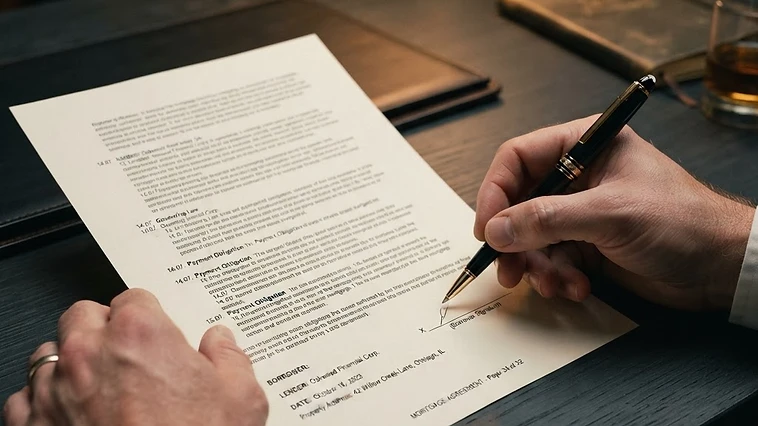 Close-up of a homeowner reviewing mortgage loan documents with a gold pen on a dark desk.

2. The MERS Illusion and Chain of Title Defects The Mortgage Electronic Registration Systems (MERS) was created by the banking industry to bypass county recording fees when mortgages are bought and sold. MERS acts as a "nominee" for the lender, but its use has severely muddied the chain of title for millions of Americans. If your deed of trust lists MERS as the beneficiary, it is highly likely that the actual ownership of your promissory note has changed hands multiple times without any public record. When you go to refinance, title companies often struggle to verify who actually holds the legal right to release the original lien, leading to massive delays.
3. Missing or Fraudulent Assignments An assignment is the legal document that transfers the rights of your mortgage from one bank to another. If your loan was securitized, there should be a clear, unbroken chain of assignments from your original lender to the current trust. In many cases, these assignments are missing entirely. In worse cases, they are fabricated years after the fact to cover up the missing paperwork.
4. Predatory Refinance Terms and Undisclosed Fees If you are currently reviewing refinance paperwork, you must be vigilant against predatory inclusions. Lenders sometimes roll undisclosed fees, inflated appraisal costs, or prepayment penalties into the new loan balance. This form of equity stripping is a subtle type of mortgage fraud that targets homeowners who have built up significant equity but fail to read the fine print of their closing disclosures.
The Mechanics of a DIY Mortgage Audit
You do not need to wait for a lawyer to tell you that your documents are flawed. Conducting a personal mortgage audit is a proactive step every homeowner should take. Here is how you can begin reviewing your own file:
First, gather every document from your original closing. This includes the Promissory Note, the Deed of Trust (or Mortgage), the Closing Disclosure (or HUD-1 Settlement Statement), and the Truth in Lending (TILA) disclosures.
Next, request a "Life of Loan" transaction history from your current servicer. Compare the payments you have made against the principal balance applied. Servicers are notorious for misapplying funds, charging unauthorized property inspection fees, or skimming money into suspense accounts without your knowledge.
Then, visit your county recorder's office (many have online portals) and pull the public property records for your home. Look for every Assignment of Deed of Trust recorded against your property. Does the chain of assignments match the letters you received in the mail regarding servicing transfers? If Bank A sold your loan to Bank B, but the county records show an assignment from Bank A directly to Bank C, you have a broken chain of title.
Finally, scrutinize the endorsements on your Promissory Note. The note is the actual IOU. If it was sold, it must be endorsed (stamped and signed) much like a check. If your servicer cannot produce a copy of the note with the proper endorsements, they may not have the legal standing to enforce the debt.
Why Auditing Your Mortgage Paperwork Matters
Ignorance is not bliss when it comes to real estate. Assuming your mortgage documents are accurate simply because you pay on time is a gamble with your most valuable asset. Whether you are preparing to refinance, considering selling your home, or just want the peace of mind that your property rights are secure, a comprehensive mortgage document review is essential.
If you wait until a servicer makes a catastrophic error, or until you are forced into a financial hardship, it will be too late to calmly and methodically untangle the web of mortgage fraud and loan document errors hidden in your file. You must take control of your paperwork today.
This is exactly why the "Foreclosure Defense Survival Playbook" is an indispensable resource for every homeowner, not just those facing default. This massive, 530-page educational manual pulls back the curtain on the banking industry's darkest secrets. It teaches you, step-by-step, how to read your mortgage contract, how to spot forged signatures and fraudulent assignments, and how to conduct a professional-level mortgage audit on your own file.
Don't wait for a bank error to threaten your home. Equip yourself with the knowledge to hold your lender accountable, ensure your refinance paperwork is pristine, and protect your family's wealth. Order the Foreclosure Defense Survival Playbook today and take the first step toward true homeowner empowerment.


Order The Playbook
Get the Foreclosure Defense Survival Playbook
530 pages of structured, educational guidance covering mortgage documents, foreclosure procedures, evidence organization, and legal research — the same foundation this article draws from.