Mortgage Documents
The Hidden Dangers in Your Mortgage Documents: Why You Need to Audit Your Paperwork Before Refinancing
Even if you are perfectly current on your payments, your mortgage file might contain hidden errors or fraudulent assignments. Learn why auditing your paperwork is critical before you refinance.

Disclaimer: The following article is for educational purposes only and does not constitute legal advice. If you require legal advice regarding your mortgage or title, please consult with a qualified attorney in your jurisdiction.
If you are a homeowner who pays your mortgage on time every single month, you probably don't spend much time thinking about the hundreds of pages of documents you signed at the closing table. You receive your monthly statement, you make your payment, and you watch your equity grow. It is entirely logical to assume that as long as your account is current, your loan file is perfectly accurate and legally sound.
Unfortunately, the residential mortgage industry is far from perfect. Even if you are not behind on your payments, your file might be hiding significant legal defects, invalid assignments, missing signatures, or even outright fraud. Whether you are planning to sell your home, or you are simply preparing to review your refinance paperwork for a better rate, assuming your lender’s documents are flawless is a dangerous gamble.
Performing a comprehensive mortgage document review is not just a tactic for homeowners facing foreclosure; it is a critical piece of financial hygiene for every property owner.
The Illusion of a Perfect Loan: Why Current Homeowners Are Still at Risk
When you close on a home or refinance a mortgage, you are signing a complex web of legal instruments. The most important of these are the promissory note (your promise to pay) and the mortgage or deed of trust (the document that gives the lender the right to take the property if you fail to pay).
In a perfect world, these documents are signed, properly notarized, recorded at the local county clerk’s office, and safely stored in a vault. In reality, the modern mortgage industry treats loans as commodities. Within days of your closing, your loan is likely sold, securitized, and transferred between multiple financial institutions, originators, and mega-servicers.
During these rapid-fire transfers, loan document errors are incredibly common. Pages go missing. Endorsements (the stamps that transfer the note from one bank to another) are left blank or forged. Assignments of the mortgage are drafted years after the fact by "robo-signers" who have no personal knowledge of the loan’s history.
If you are a homeowner in good standing, you might wonder why this matters. It matters because title defects do not magically resolve themselves. If your mortgage was improperly assigned through the Mortgage Electronic Registration Systems (MERS) or if your deed of trust was recorded with an incorrect legal description, that cloud on your title remains. When you eventually attempt to sell the property or sign new refinance paperwork, these hidden defects can delay your transaction, incur unexpected legal fees, or completely derail your financial plans. A proactive mortgage audit is the only way to uncover these landmines before they explode.
Late August 2026 News: Federal Sentencings Reveal Rampant Mortgage Document Schemes
If you think document irregularities are a relic of the 2008 financial crisis, recent headlines prove otherwise. In late August 2026, the United States Department of Justice (DOJ) announced multiple enforcement actions and sentencings that highlight how vulnerable the mortgage system remains to fabricated documents.
On August 27, 2026, a federal judge in Pennsylvania sentenced a man to 21 months in federal prison for executing a massive residential mortgage fraud scheme. The individual had provided a bank with altered statements to falsely inflate his account balances by hundreds of thousands of dollars, securing a $773,000 residential loan based entirely on fraudulent paperwork.
Just a week prior, on August 19, 2026, another individual in New Jersey pleaded guilty to participating in a multi-million-dollar mortgage fraud conspiracy. In that case, the fraudsters created fake documentation that purportedly transferred control of multiple properties. They generated fraudulent letters claiming massive funds had been deposited into escrow accounts and presented these fabricated documents to mortgage lenders to fund millions of dollars in loans.
These cases underscore a chilling reality: major financial institutions and settlement companies are routinely duped by fake paperwork. If multi-billion-dollar banks can be tricked into funding loans based on altered bank statements and fabricated property transfers, what makes you confident that the documents they drafted and recorded against your home are meticulously accurate? The system is inherently vulnerable to human error and deliberate deception, making it essential for homeowners to conduct a personal mortgage document review.
The New Threat: Artificial Intelligence and Refinance Paperwork
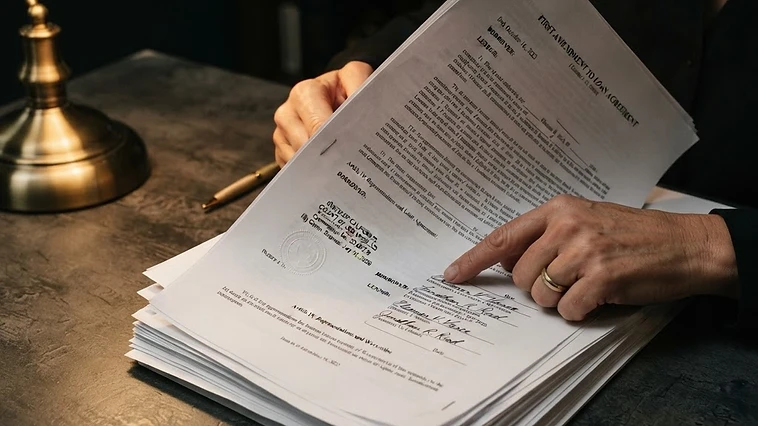 A close-up view of a homeowner reviewing physical refinance paperwork to detect mortgage fraud and loan document errors on a dark desk.

The risk of document fabrication has recently accelerated due to the rapid advancement of artificial intelligence. Throughout the summer of 2026, banking officials and federal regulators have been raising alarms over the ease with which AI can generate hyper-realistic fake documents.
Fraudsters no longer need sophisticated software or specialized skills to forge a document. In seconds, AI can generate pixel-perfect pay stubs, W-2s, tax returns, and even title transfer documents. While these tools are primarily used by bad actors to commit mortgage fraud on the origination side, the fallout pollutes the entire public land record system.
When you sit down to sign your refinance paperwork, the title company is relying on historical public records to ensure that the new lender will have a clean, first-priority lien on your property. However, if the historical chain of title includes fraudulent releases, AI-altered assignments, or fabricated notarizations from previous transactions, your new loan is being built on a legally compromised foundation.
You cannot rely exclusively on your current servicer or title company to catch these granular defects. They are processing thousands of files a month and often rely on automated software to check the boxes. By learning how to spot loan document errors yourself, you act as the final line of defense for your property rights.
Red Flags to Look For in Your Own Mortgage Paperwork
So, what exactly should you be looking for when you pull your file out of the filing cabinet or download it from your county recorder’s website? Conducting a basic mortgage audit involves scrutinizing the chain of custody and the physical integrity of the documents. Here are a few major red flags to look for:
1. Notary and Signature Irregularities
Look closely at the notary stamps and signatures on your mortgage or deed of trust. Does the date of the notarization match the date you actually signed the documents? Are you certain you were in the state or county listed on the notary block on that specific day? In many documented cases of mortgage fraud, documents are notarized days or weeks after the closing by individuals who were never in the same room as the borrower.
2. The MERS Maze
If your mortgage includes MERS (Mortgage Electronic Registration Systems) as a nominee for the lender, pay close attention to any recorded assignments. MERS was created to bypass the county recording system so banks could trade loans faster. However, this often leads to legally questionable assignments. Check your county records to see if MERS assigned your mortgage to a new trust or bank. Are the individuals who signed that assignment actually employees of MERS, or are they employees of your servicer acting under questionable corporate resolutions?
3. Missing Promissory Note Endorsements
Your promissory note is the actual IOU. When a loan is sold, the note must be properly endorsed to the new owner, much like a check. If your servicer claims that your loan has been sold three times, but the copy of the note they provide you has no endorsements—or features an undated "blank endorsement" that magically appeared years later—this is a massive red flag.
4. Predatory Refinance Terms and Junk Fees
If you are currently reviewing new refinance paperwork, scrutinize the closing disclosures with a magnifying glass. Predatory lenders often hide exorbitant junk fees, yield spread premiums, or dangerous adjustable-rate triggers deep within the fine print. Ensure that the terms match the original loan estimate and that you are not being charged for unnecessary "points" that do not actually lower your interest rate.
Why You Cannot Rely on the Lender’s Word
A common misconception among homeowners who are current on their payments is that their mortgage servicer has their best interests at heart. In reality, a mortgage servicer is essentially a debt collector managing an account for a distant pool of investors. Their priority is maximizing revenue and minimizing operational costs, not ensuring the pristine legal accuracy of your property records.
If you request a copy of your loan file, the servicer will likely send you a standard packet. But is it the complete packet? Does it include the loan history, the servicing disclosures, the original application, and the collateral file? Often, it takes a formal, legally formatted request (such as a Qualified Written Request or Notice of Error under the Real Estate Settlement Procedures Act) to compel a servicer to hand over the actual documents.
Waiting until a crisis hits—like a sudden job loss, a medical emergency, or a contested divorce—is the worst possible time to discover that your loan file is a mess. By initiating a thorough mortgage document review while the waters are calm, you retain the upper hand. You have the time and clarity to demand corrections, clear title issues, and hold lenders accountable before you ever sign another piece of paper.
Why Auditing Your Mortgage Paperwork Matters
Even if you have paid on time for a decade, you must verify what is legally attached to your home. Auditing your mortgage paperwork matters because your home is likely your most valuable asset, and a single forged signature or missing assignment can jeopardize your ability to refinance, sell, or pass the property on to your heirs. The recent surge in DOJ mortgage fraud prosecutions and the rise of AI-generated fake documents prove that the system is dangerously flawed. You cannot blindly trust that the documents a lender or servicer handed you are accurate.
If you are preparing to refinance, or if you simply want to ensure your property rights are bulletproof against future legal challenges, you need the right tools to uncover the truth. This is exactly why the Foreclosure Defense Survival Playbook is an essential addition to your library.
The Playbook is not just for homeowners facing default; it is a comprehensive, 530-page educational resource designed to empower every homeowner. It teaches you step-by-step how to conduct a personal mortgage audit, spot predatory lending tactics, identify missing endorsements, and organize your evidence like a seasoned forensic professional. Do not wait for a title nightmare or a servicing error to threaten your home. Order the Foreclosure Defense Survival Playbook today, and take absolute control of your mortgage documents before you sign your next refinance.


Order The Playbook
Get the Foreclosure Defense Survival Playbook
530 pages of structured, educational guidance covering mortgage documents, foreclosure procedures, evidence organization, and legal research — the same foundation this article draws from.