Mortgage Documents
The Hidden Dangers in Your Mortgage: Why Current Homeowners Must Audit Their Documents Before Refinancing
Even if you pay your mortgage on time, hidden loan document errors and servicing fraud could jeopardize your upcoming refinance or leave you vulnerable to predatory practices.


Disclaimer: The following article is for educational purposes only and does not constitute legal advice. Always consult with a qualified attorney regarding your specific legal situation.
If you are a homeowner who pays your mortgage on time every single month, you might assume your loan file is in perfect order. You receive your monthly statement, you make your payment, and your balance slowly decreases. When interest rates drop or you need to tap into your home's equity for renovations, you naturally start gathering your refinance paperwork. You trust that the bank, the title company, and the mortgage servicer have accurately recorded your financial history and legal standing.
Unfortunately, this assumption can be a costly mistake.
Recent enforcement actions, court rulings, and industry reports reveal a troubling reality: the mortgage industry is still plagued by systemic errors, missing assignments, predatory practices, and outright fraud. Even homeowners who are perfectly current on their payments are discovering that their original loan documents are defective, their payments have been misapplied, or their title is clouded by fraudulent activity. Before you sign a new stack of refinance paperwork, conducting a thorough mortgage document review is one of the most critical steps you can take to protect your most valuable asset.
The Rising Threat of Mortgage Fraud and Synthetic Identity Schemes
Mortgage fraud is not a relic of the 2008 financial crisis; it is an evolving and escalating threat. According to recent industry data, the CoreLogic Mortgage Application Fraud Risk Index increased 8.3% nationwide over the last year, with an estimated one in 123 mortgage applications showing indications of fraud Mortgage Fraud Risk Up 8.3% From Last Year – NMP.
While much of this data focuses on the origination of new loans, the underlying mechanisms of this fraud directly impact existing homeowners. Bad actors are increasingly using artificial intelligence and compromised personal data—such as Social Security numbers, employment details, and past addresses—to construct highly convincing, synthetic borrower profiles Mortgage Fraud Trends in the Age of AI: What Lenders Need to Know in 2026. These deepfake digital impersonations can be used to fraudulently refinance properties, strip equity, or file bogus deeds against homes owned by unsuspecting, on-time borrowers.
Furthermore, predatory real estate schemes continue to target vulnerable populations. Recent lawsuits have highlighted operators running foreclosure rescue scams and predatory refinance operations that trick homeowners into signing over the deeds to their homes under the guise of loan modification or refinancing Mortgage Fraud Blog | Mortgage Fraud and Real Estate Fraud. If you are rushing through your refinance paperwork without a critical eye, you could easily fall victim to hidden clauses, inflated appraisals, or predatory terms designed to siphon away your hard-earned equity.
Recent Enforcement Actions Highlight Servicing and Title Abuses
Even if you are dealing with a well-known mortgage servicer, you cannot assume your account is being handled legally or accurately. Federal regulators are actively cracking down on servicers and title companies for egregious violations of consumer protection laws.
For example, the Consumer Financial Protection Bureau (CFPB) recently took action against Fay Servicing for illegal foreclosure practices and violating a previous law enforcement order, resulting in a $2 million penalty and $3 million in consumer redress CFPB Takes Action Against Fay Servicing for Illegal Foreclosure Actions and Violating Law Enforcement Order | Consumer Financial Protection Bureau. While this specific action involved foreclosure abuses, the root cause of such illegal activity often stems from sloppy record-keeping, misapplied payments, and a fundamental failure to maintain accurate loan documents.
Title companies and mortgage brokers are also facing scrutiny. In a recent case, a title company owner pleaded guilty to wire fraud after misappropriating real estate settlement funds Mortgage Fraud Blog | Mortgage Fraud and Real Estate Fraud. In another instance, a mortgage broker was found to have submitted falsified income documents, including fake tax returns, to lenders Mortgage broker submitted 'falsified' documents: BCFSA.
When the professionals handling your closing are cutting corners or committing fraud, the resulting loan document errors become your problem. If a title company fails to properly record a release of lien from your previous mortgage, or if a broker falsifies data on your application, it can cloud your title and create massive legal headaches when you attempt to refinance or sell your home.
Common Loan Document Errors Hiding in Plain Sight
When you sit down to conduct a mortgage document review, you aren't just looking for obvious typos. You are looking for structural, legal defects that could invalidate the lender's security interest in your home or prove that you have been overcharged. Here are some of the most common loan document errors hiding in plain sight:
1. Missing or Fraudulent Assignments
When your mortgage is sold from one lender to another—which happens frequently in the secondary mortgage market—the transfer must be legally documented through an "Assignment of Mortgage" or "Assignment of Deed of Trust." Often, these assignments are never properly recorded in the county land records, or they are "robo-signed" by individuals who have no actual knowledge of the documents they are signing. If the chain of title is broken, the current servicer may not actually have the legal standing to collect your payments or authorize a refinance payoff.
2. MERS Discrepancies
The Mortgage Electronic Registration Systems (MERS) was created by the banking industry to bypass county recording fees by tracking mortgage transfers electronically. However, MERS has been at the center of countless legal disputes regarding its authority to assign mortgages or initiate foreclosures. If MERS is listed as the nominee on your Deed of Trust, you must verify that the electronic records match the physical reality of who actually owns your Promissory Note.
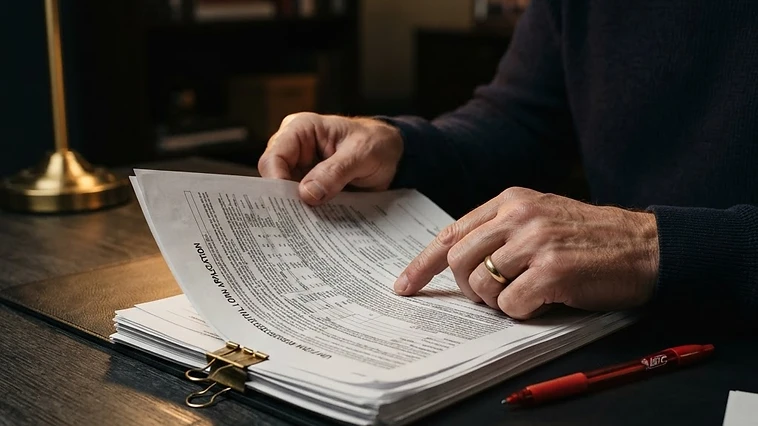 Homeowner conducting a mortgage document review on a dark desk with a gold accent lamp.

3. RESPA and Regulation X Violations
Under the Real Estate Settlement Procedures Act (RESPA) and the related Regulation X, mortgage servicers must follow strict rules regarding the management of home loans, including the prompt crediting of payments and the accurate calculation of escrow accounts Mortgage Foreclosure Defense in Pittsburgh | Gomez. If your servicer has been misapplying your principal and interest payments, charging you for unnecessary force-placed insurance, or miscalculating your property taxes, your payoff quote for a refinance will be artificially inflated. You could end up rolling thousands of dollars of illegal junk fees into your new loan.
4. Notary and Signature Irregularities
Take a close look at the notary stamps and signatures on your original closing documents. Were you actually present in the room with the notary on the date stamped on the document? Are the signatures consistent? Fraudulent notarizations are a hallmark of predatory lending and title fraud. If your documents were improperly notarized, they may be legally voidable.
Why a Proactive Mortgage Audit is Essential Before Refinancing
Many homeowners believe that a mortgage audit is only necessary if they are facing foreclosure. This is a dangerous misconception. A proactive mortgage audit is a vital financial health check that every homeowner should perform before signing new refinance paperwork.
When you refinance, you are essentially paying off your old loan with a new one. The new lender will request a "payoff statement" from your current servicer. If your current servicer has been misapplying your payments, charging illegal fees, or miscalculating your escrow, that payoff amount will be wrong. By blindly agreeing to the payoff amount, you are permanently capitalizing those errors into your new loan. You will pay interest on those illegal fees for the next 15 to 30 years.
Furthermore, the refinance process requires a clear title. If your original loan documents contain unrecorded assignments, missing signatures, or fraudulent liens, the title search will flag these defects. This can delay your refinance, cause you to lose a favorable interest rate lock, or force you to spend thousands of dollars on a quiet title action to fix the bank's mistakes.
By conducting a mortgage document review before you apply for a refinance, you take control of the narrative. You can force the servicer to correct accounting errors under RESPA, demand proof of ownership, and ensure that your title is clean and ready for transfer.
How to Start Reviewing Your Mortgage Paperwork
If you are ready to take control of your financial future, you need to gather your documents and start reading. Here is a basic framework for beginning your review:
- Gather the Core Documents: You need your original Promissory Note (including any allonges or endorsements), your Mortgage or Deed of Trust, your Closing Disclosure (or HUD-1 Settlement Statement if your loan is older), and your complete payment history from the servicer.
- Send a Notice of Error or Request for Information: Under RESPA, you have the right to send a written Request for Information (RFI) or Notice of Error (NOE) to your servicer. The servicer is legally required to acknowledge your request and provide the requested documents, such as the identity of the actual owner of your loan and a detailed transaction history.
- Check the Math: Compare your payment history against your own bank statements. Did the servicer credit your payments on the exact day they were received? Have they assessed unexplained late fees or property inspection fees even though you are current on your loan?
- Verify the Chain of Title: Visit your county recorder's office (many have online portals) and pull the property records for your home. Does the recorded history of assignments match the letters you received in the mail telling you that your servicer had changed?
If you spot discrepancies, do not ignore them. These "minor clerical errors" are often the tip of the iceberg of systemic mortgage fraud.
Why Auditing Your Mortgage Paperwork Matters
Even if you have never missed a payment, the integrity of your mortgage documents dictates the security of your home equity. The banking industry relies on the fact that the average homeowner will never read past the first page of their refinance paperwork. They count on you to blindly trust their accounting, their legal standing, and their payoff quotes.
Auditing your mortgage paperwork matters because it is the only way to ensure you are not being quietly robbed by the very institutions you trust to hold your mortgage. Whether you are preparing to refinance, looking to remove private mortgage insurance, or simply want peace of mind, you must know exactly what is in your loan file.
This is exactly why the Foreclosure Defense Survival Playbook is an indispensable resource for every homeowner, not just those in financial distress. This comprehensive, 530-page educational manual pulls back the curtain on the mortgage industry. It teaches you step-by-step how to read complex mortgage documents, how to spot the hidden loan document errors that cost homeowners thousands, and how to organize your evidence like a seasoned auditor.
Before you sign your name to another 30-year commitment, arm yourself with the knowledge to protect your equity. The Foreclosure Defense Survival Playbook provides the exact frameworks, legal research strategies, and document analysis techniques you need to ensure your refinance paperwork is accurate, lawful, and free of fraud. Don't wait for a crisis to discover your documents are defective—order the Playbook today and take absolute control of your home's financial future.


Order The Playbook
Get the Foreclosure Defense Survival Playbook
530 pages of structured, educational guidance covering mortgage documents, foreclosure procedures, evidence organization, and legal research — the same foundation this article draws from.